How High to Hang Pictures (and Gallery Walls)
Hang pictures so their center sits 57 to 60 inches from the floor, then adjust for sofas, beds, mantels, stairs, high ceilings, and dining rooms. The formula, the exceptions, and how to check it before you drill.
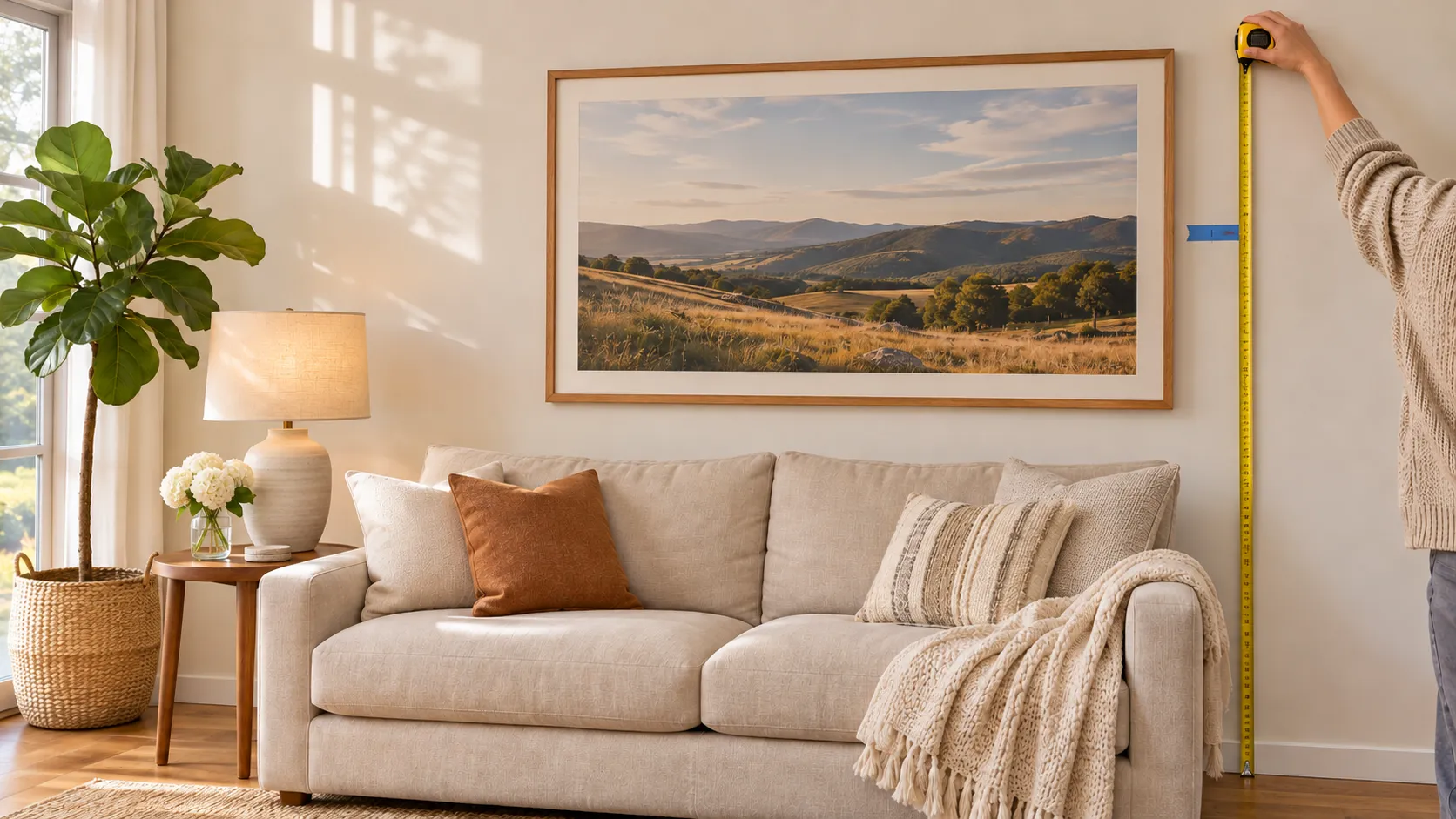
Quick answer: Hang a picture so its center is 57 to 60 inches (145 to 150 cm) from the floor. For a gallery wall, use the center of the whole group, not each frame. Above furniture, ignore the number and leave 6 to 10 inches between the furniture and the bottom of the art instead. On stairs, measure up from the steps, not the floor, and go a little lower: about 48 to 56 inches above the stair edge.
Pictures hung too high are the most common mistake in decorating, and it’s easy to see why. When you hold a frame up against the wall, you hold it where your hands are comfortable, which is usually above your head. The art ends up floating near the ceiling, disconnected from the room.
Eye level fixes that. It’s not a law, but it’s a good default, and knowing why it works makes the exceptions easier.
The 57 to 60 inch rule
Galleries and museums commonly hang art with its center around 57 to 60 inches from the floor. That’s roughly the eye height of an average adult standing, so the art is easy to look at without tilting your head.
Use 57 inches as a starting point in rooms with standard 8-foot ceilings, and closer to 60 in taller rooms or if your household runs tall.
How to find the height for one picture
You mark nails, not centers, so convert:
- Pick the center height. Say 58 inches.
- Add half the frame’s height to get the top of the frame. Use the outside height, edge to edge, not the photo size the frame is sold by. A frame that measures 16 x 20 inches outside, hung tall: 58 + 10 = 68 inches.
- Subtract the hanger drop to get the nail height. If the wire pulls tight 4 inches below the top: 68 − 4 = 64 inches.
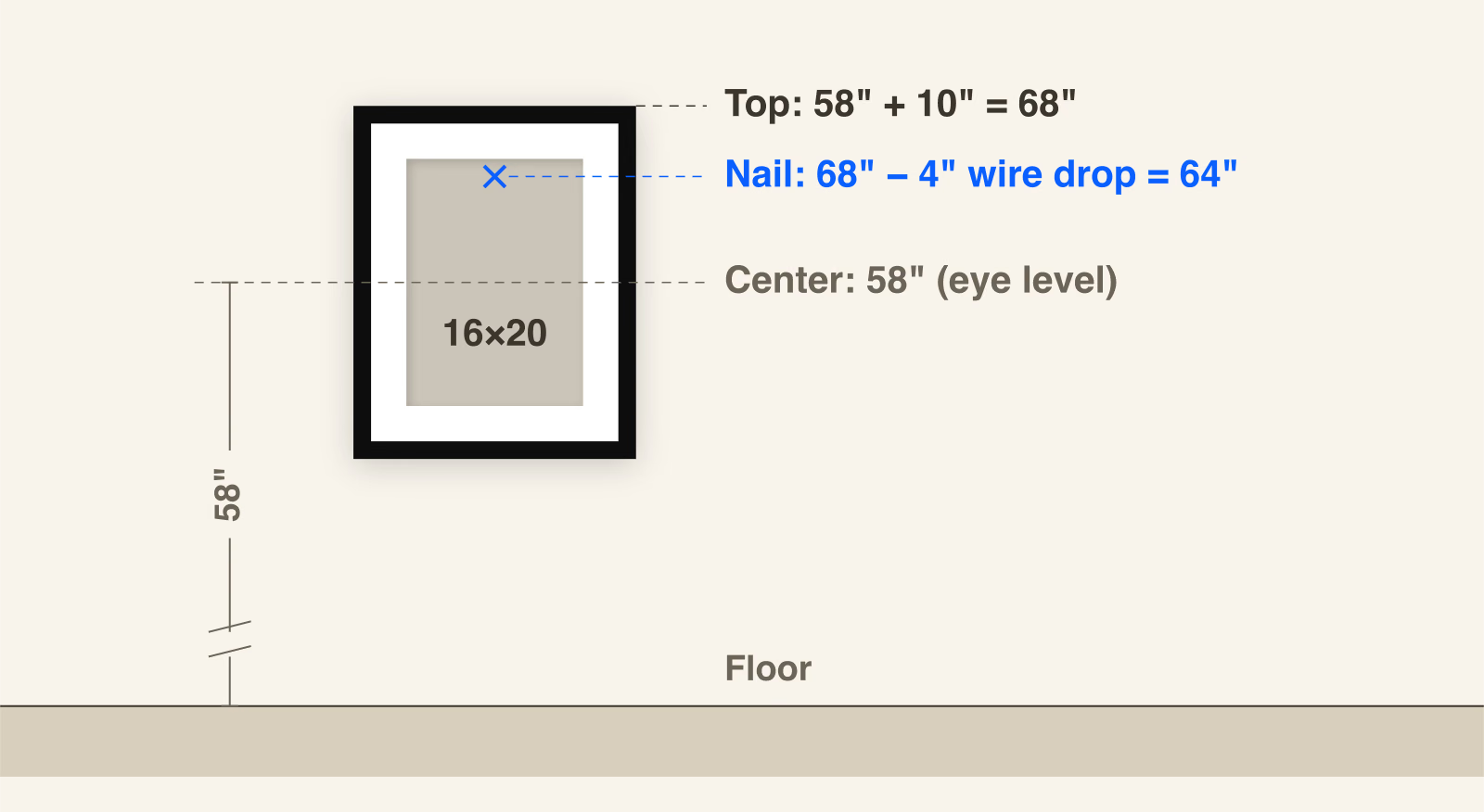
Step 3 is where frames end up too high. Where to put the nail walks through measuring the drop for wire, D-rings, and sawtooth hangers.
How high to hang a gallery wall
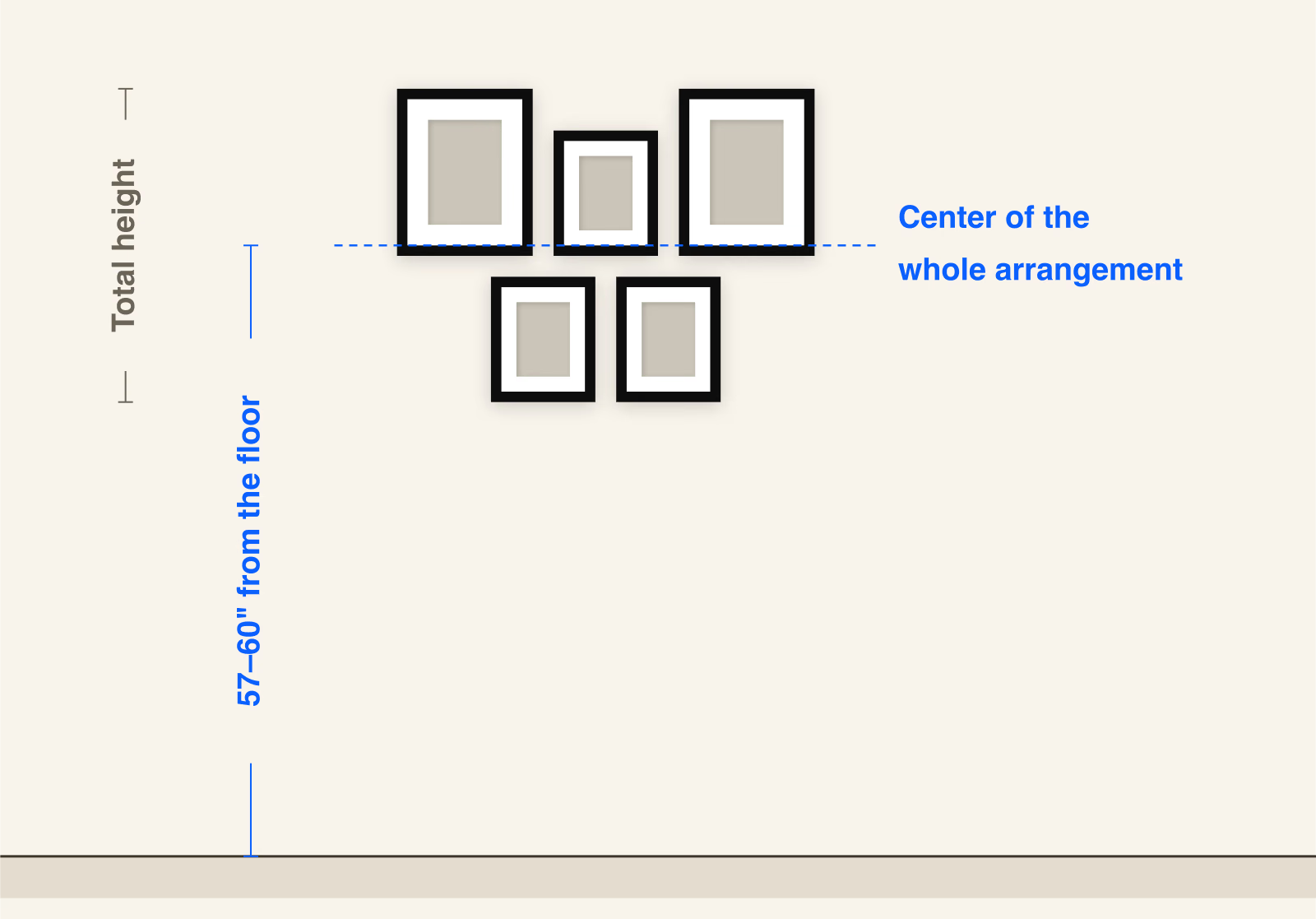
Treat the whole arrangement as one big picture. Its center, not each frame’s, goes at 57 to 60 inches.
- Measure the full height of the arrangement, from the top of the highest frame to the bottom of the lowest.
- Halve it.
- Add that to your center height. That’s where the top of the tallest frame lands.
A gallery wall 40 inches tall, centered at 58 inches: the top sits at 58 + 20 = 78 inches and the bottom at 38 inches.
Very tall arrangements are the exception. If centering at 58 puts the bottom row below about 30 inches, it’ll be hidden behind furniture or feel like it’s sinking. Raise the whole group until the bottom clears, and accept a higher center.
Above a sofa, bed, or console
Furniture changes the rule. The art should look like it belongs to the piece below it, so measure from the furniture, not the floor.
| Above | Gap from furniture to bottom of art |
|---|---|
| Sofa | 6 to 10 inches above the back |
| Bed | 8 to 10 inches above a low headboard; only 4 to 6 above a tall upholstered one (48 inches or more) |
| Console table or dresser | 6 to 10 inches above the top (leave room for lamps) |
| Mantel | 4 to 8 inches above the mantel shelf |
| Desk | 8 to 12 inches, so you don’t hit it with a monitor |
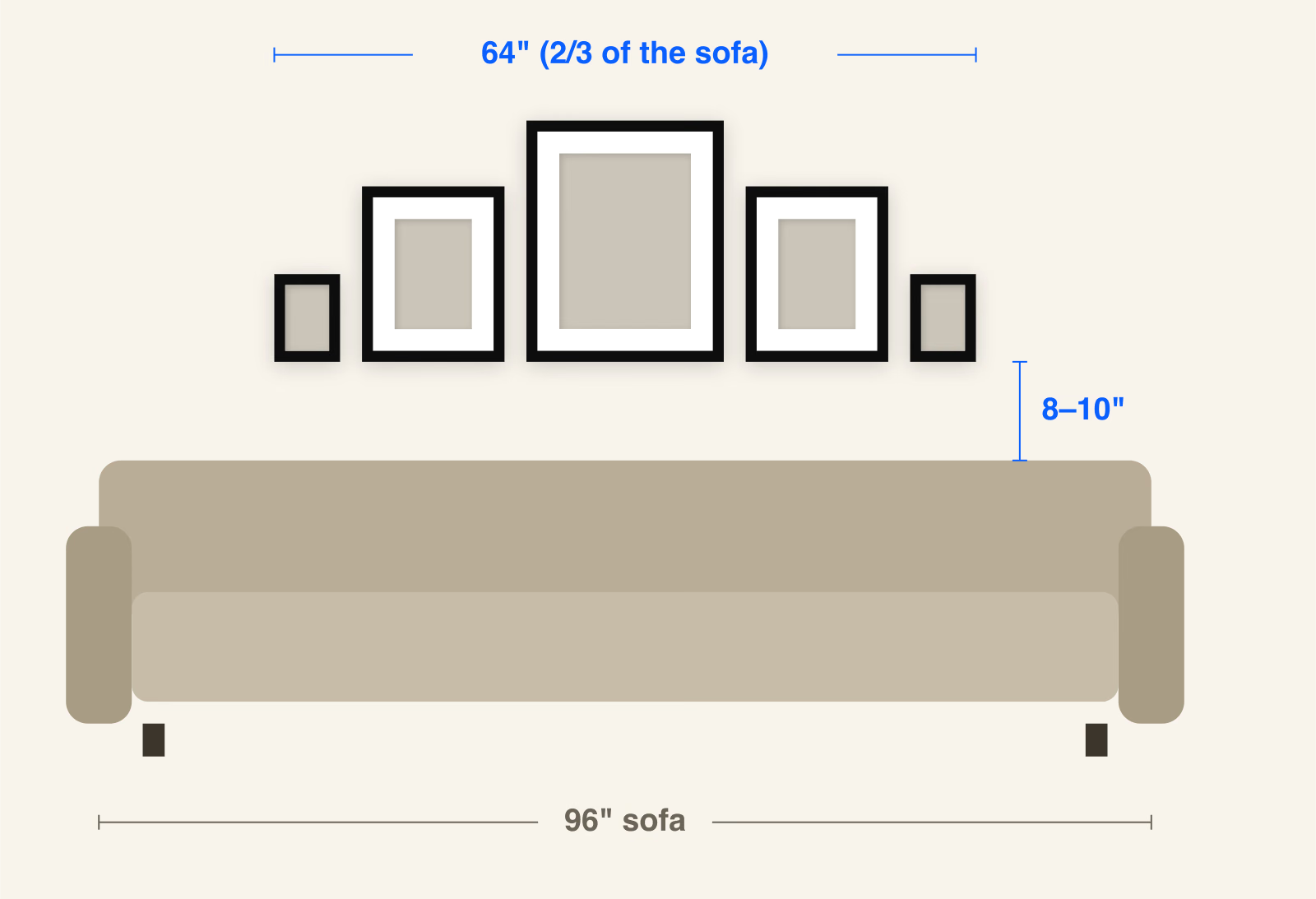
Leave more than a foot and the art floats away from the furniture. Go tighter than 4 inches and it looks crammed, and you’ll knock it with your head on a sofa or bed.
Width matters as much as height here: about two thirds of the furniture’s width is a good target. The furniture guide goes deeper on both.
On a staircase
Eye level moves as you climb, so the floor stops being useful. Measure from the stairs instead:
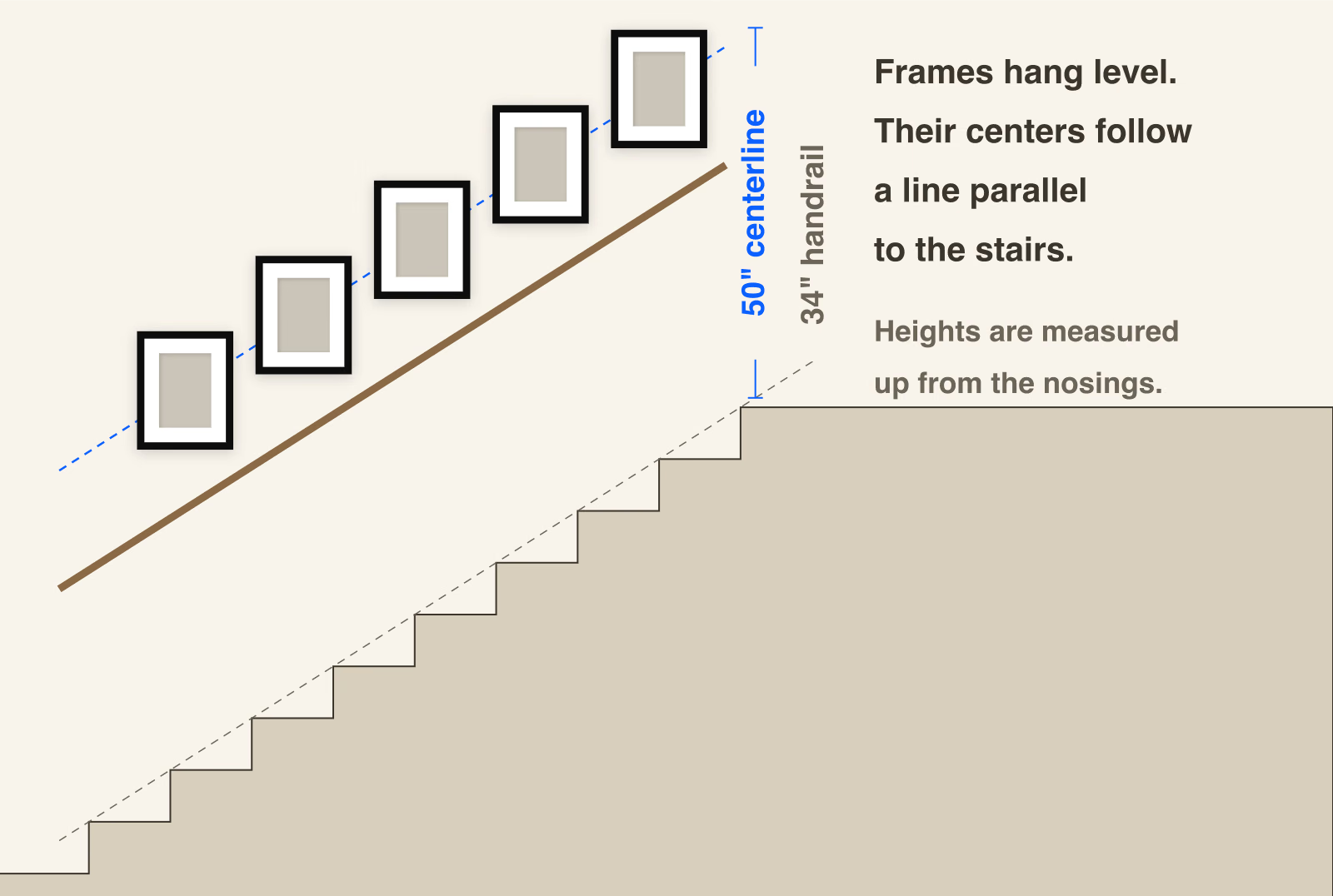
- At each frame’s position, measure straight up from the line through the front edges (nosings) of the steps. Between nosings the tread sits lower, so stretch a string from nosing to nosing rather than measuring off the tread.
- Put the center of the arrangement about 48 to 56 inches above that point: around 50 inches with a standard 34-inch handrail, a little higher with a taller rail.
- The centers then form a line parallel to the stairs, and the arrangement climbs with you.
That’s lower than on a flat wall because you’re standing on a step and viewing the wall up close as you climb.
For headroom, landings, and layouts that suit a slope, see the staircase guide.
Other exceptions
- High ceilings. Keep the center near eye level, even with 10- or 12-foot ceilings. Fill the extra height with bigger art or a taller arrangement, not by hanging higher. Art that drifts up to “fill the wall” looks lost.
- Dining rooms and sitting areas. If people mostly look at the wall while seated, you can drop the center a few inches, to around 50 to 54 inches.
- Hallways. Stick to eye level. People view hallway art while walking past at close range, so higher is harder to see.
- Kids’ rooms. Hang at their eye level if the art is for them, around 40 to 48 inches. Use lighter frames and acrylic instead of glass.
- Next to a window or door. Line up with the top of the trim if it’s close to your eye-level height. Matching an existing line usually beats hitting an exact number.
Check it before you drill
Before any nails: cut paper templates the size of each frame, tape them up at your planned height, and look from where you’ll usually see the wall. From the sofa. From the doorway. Live with it for a day if you’re unsure. Moving tape is free.
Set your eye level in GalleryPlanner
GalleryPlanner draws eye level on the wall so you can see it while you plan, not just when you measure.
- Eye-level Guide: Turn it on from the Settings menu in the header (on phones, in Settings) and a line appears across the wall at your eye level. On a staircase wall it runs parallel to the stairs, at your eye level above them.
- Your own eye level: Change the height in Settings → Canvas → Eye level. The default is 60 inches (150 cm in metric). Set it to 57, or lower it for a dining room.
- Starter Layouts land at eye level (Pro): On a flat wall, a Starter Layout you apply lands with its middle at your Eye level. It stays centered on the wall instead when it would come within 2 inches of the ceiling, wouldn’t fit above the floor, or would cover a Wall Object like a TV that the centered spot clears. On stairs, Starter Layouts land above the stairs, centered left to right.
- Curated Auto-Layout (Pro): The Curated option arranges your frames based on real-life gallery walls and places the result near eye level. On a staircase wall it centers the arrangement above the stairs.
- Eye Level button (Pro): Select frames and choose Eye Level from the selection toolbar’s align menu to center them on your eye-level line in one click.
Once the height looks right, the Hanging Guide (Pro) gives every frame’s position measured from the floor, or from the stairs on a staircase wall, so the height you planned is the height you hang.
Plan your wall for free and turn on the Eye-level Guide.
Frequently Asked Questions
How high should you hang pictures? Put the center of the picture 57 to 60 inches from the floor. That’s average standing eye level and a range galleries and museums commonly use.
How high should a gallery wall be? Center the whole arrangement, not each frame, at 57 to 60 inches. Measure the arrangement’s total height, halve it, and add that to your center height to find where the top of the tallest frame goes.
How high should I hang art above a sofa? Leave 6 to 10 inches between the top of the sofa back and the bottom of the art, even if that puts the center higher or lower than 57 to 60 inches.
How high should pictures be above a bed? About 8 to 10 inches above a low headboard. A tall upholstered headboard (48 inches or more) already acts as a base, so leave only 4 to 6 inches. Use D-rings or secure hooks rather than wire, and lighter frames over where people sleep.
Should I hang pictures higher with high ceilings? Not much. Keep the center near eye level and use larger art or a taller arrangement to fill the height.
What is the 57 inch rule? It’s a common gallery and museum guideline: hang art with its center about 57 inches from the floor, near the eye height of an average adult. Many designers use anywhere from 57 to 60 inches.
How do I hang pictures on a staircase? Measure up from the line through the front edges (nosings) of the steps, at each frame’s position, and keep the arrangement’s center about 48 to 56 inches above that point, around 50 inches with a standard handrail. The frames then follow the slope of the stairs.
Ready to Keep Planning?
Open GalleryPlanner and jump back into your current wall plan without forcing you into a specific tool first.
Launch GalleryPlanner