How Much Does a Gallery Wall Cost?
Estimate a realistic gallery wall budget across ready-made frames, custom framing, prints, hardware, and professional installation, with practical ways to avoid overspending before you buy.
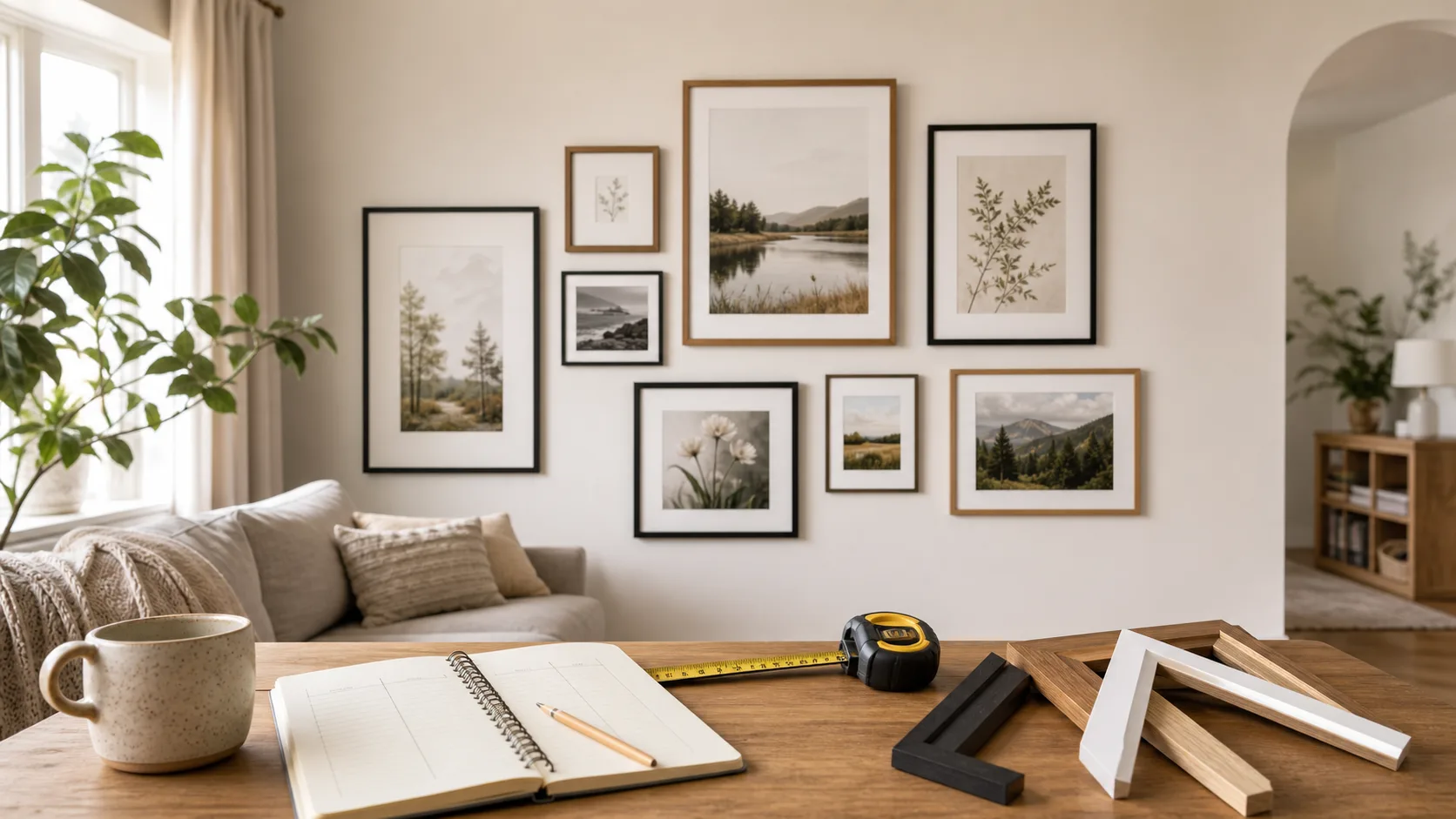
A gallery wall can cost less than $150 if you use budget ready-made frames and hang it yourself. Many finished walls land closer to $300-$1,000 once you add nicer frames, prints, mats, and hardware. Custom-framed gallery walls can pass $1,500 quickly, and professional installation adds another labor line.
The honest answer is that a gallery wall is not one product with one price. It is a set of choices: how many pieces, what frame quality, whether you already own the art, how difficult the wall is, and whether you want someone else to hang it.
| Project type | Planning range | What usually drives it |
|---|---|---|
| Budget DIY wall | Under $150-$300 | Ready-made frames, existing photos or inexpensive prints, basic hardware |
| Mid-range wall | $300-$1,000 | Better ready-made frames, larger pieces, mats, cohesive finishes |
| Custom-framed wall | $600-$2,000+ | Custom sizing, specialty mats, UV glazing, larger artwork |
| Professional installation | Add roughly $100-$350 per job, or more for complex work | Piece count, heavy frames, wall material, layout precision |
Use those as planning ranges, not quotes. A five-frame wall with IKEA frames can cost less than one custom-framed statement piece. A brick stair wall with oversized art can cost more to install than the frames themselves.
What Actually Drives Gallery Wall Cost
The biggest cost driver is usually the frame strategy. Budget retail frames can be very inexpensive: IKEA’s RÖDALM line, for example, currently lists 16x20 frames around the $15-$20 range depending on finish, with smaller sizes below that (GalleryPlanner’s Add Frame → Brands tab has these as presets with the real outer and mat-opening sizes filled in — see the IKEA frame size guide). That makes a small, consistent wall possible without a large budget.
Premium bundled gallery wall services sit at the other end of the ready-made market. Level Frames lists curated gallery wall sets from a few hundred dollars into the high hundreds depending on frame count and layout. You are paying for the frames, but also for convenience: a predesigned arrangement, coordinated sizes, and fewer decisions. For a rundown of the shops that sell gallery walls as a set, see Pre-Made Gallery Wall Layouts.
Custom framing changes the math fastest. American Frame’s current custom framing guide puts a medium 16x20 art print around $75-$250 depending on materials, with full-service labor often adding more. Multiply that across four to six pieces and a “small” gallery wall can become a four-figure project before installation.
The other costs are smaller but still worth budgeting:
| Cost component | Budget impact | Notes |
|---|---|---|
| Frames | Low to very high | Main swing factor; standard sizes cost far less than custom |
| Prints or artwork | Low to high | Existing photos are cheapest; fine-art prints and originals raise the budget |
| Mats and glazing | Medium to high | Wider mats, UV glass, and archival materials add polish and cost |
| Hanging hardware | Low | Angi estimates basic DIY picture-hanging hardware around $2-$15 if you already own tools |
| Installation | Medium to high | Professional hanging often becomes worthwhile for heavy, large, or complex walls |
| Returns and mistakes | Sneaky | Buying the wrong size or too many frames is one of the easiest ways to waste money |
That last line is where planning matters. You can change a 12x16 frame to an 11x14 frame on screen for free. Changing it after ordering six frames is slower and more expensive.
Three Realistic Budget Examples
Budget DIY Wall: $125-$300
This is the “make it look good without overthinking it” version:
| Item | Example budget |
|---|---|
| 5 ready-made frames | $50-$150 |
| Photo prints or inexpensive art prints | $15-$60 |
| Basic hooks, strips, or anchors | $5-$25 |
| Total | $75-$235, with cushion to about $300 |
This works best when you choose standard frame sizes, keep the finish consistent, and hang on normal drywall. The wall does not need to look cheap. A clean grid of matching black, white, or wood frames can look intentional even when every piece came from a budget retailer.
For deeper shopping tradeoffs, use the frame-buying guide. This article is about the total budget, not which store to choose.
Mid-Range Styled Wall: $300-$1,000
This is the range many homeowners actually hit when they want the wall to feel finished:
| Item | Example budget |
|---|---|
| 4-8 nicer ready-made or semi-custom frames | $200-$700 |
| Prints, mats, or a few upgraded pieces | $50-$250 |
| Hardware and small tools | $15-$50 |
| Total | $265-$1,000 |
The cost rises because size and finish start to matter. Larger frames are more expensive, mats make the wall feel more polished, and mixing one or two premium pieces with budget frames can be a good compromise.
This is also the range where layout mistakes hurt. If you buy eight small frames and later realize the wall needs three larger anchors, the “cheap” version gets expensive fast.
Custom-Framed Statement Wall: $600-$2,000+
Custom framing is worth it for original art, odd sizes, valuable photos, textiles, signed prints, or a wall you expect to keep for years. It is not necessary for every family photo.
| Item | Example budget |
|---|---|
| 4-6 custom-framed pieces | $600-$1,800+ |
| Specialty glazing, mats, or oversized work | Adds quickly |
| Professional installation, if needed | $100-$350+ |
| Total | Often $800-$2,000+ |
The budget can be worth it, but only when the layout is already settled. Before ordering custom work, confirm the outer frame sizes, wall scale, and spacing. Custom framing is hard to return, and a beautiful frame still looks wrong if it is too small for the wall.
If your goal is a custom look without custom prices, the DIY matting and framing guide covers that path in detail.
DIY vs. Professional Installation
DIY hanging keeps the budget low, especially for lightweight frames on drywall. You will usually need only basic hooks, adhesive strips, anchors, a level, a tape measure, and patience.
Professional installation becomes easier to justify when:
- the wall is brick, plaster, concrete, or unusually textured
- the pieces are heavy, oversized, valuable, or awkward to align
- the layout wraps around stairs, windows, or furniture
- you want a precise salon wall and do not want to spend a weekend adjusting it
- a mistake would damage the wall or the artwork
Current installation guides vary by market and job shape. Thumbtack lists art installation around $55-$165 per piece nationally. Swivl’s picture-hanging guide places many standard jobs around $120-$350, with more complex gallery-wall work higher. Angi’s handyman listings put general handyman labor around $40-$140 per hour.
Those ranges explain why it helps to separate the frame budget from the install budget. A $250 DIY wall can become a $500 wall if you hire help. A $1,500 custom-framed wall may deserve professional hanging because the downside of a crooked or damaged install is higher.
For hardware specifics, use the hanging hardware guide. This article stops at the budget decision.
How to Keep Costs Down Without Making It Look Cheap
The best cost cuts are the ones that simplify the wall instead of making it feel unfinished.
Use fewer, larger pieces. A wall of fifteen tiny frames can cost more than five medium frames and still feel busier. Larger pieces often make a wall feel more intentional.
Choose standard sizes before you shop. Standard frame sizes are cheaper, easier to replace, and easier to mat. If your photo crop is unusual, consider printing with a border or using a mat instead of custom-framing every piece.
Source vintage or used frames selectively. Thrift stores, estate sales, flea markets, Facebook Marketplace, and local reuse shops can turn framing into the cheapest part of the project. The tradeoff is time: found frames may need cleaning, new backing, new hardware, paint, or custom mats. Use this path for character pieces or salon-style walls, then follow the vintage and upcycled frame guide for making mismatched sizes feel intentional.
Keep one thing consistent. Matching every frame is not required. But the wall usually needs one unifying decision: frame color, mat color, art style, or spacing.
Spend on the anchor pieces. If you want one custom-framed hero photo or original artwork, let that piece carry the wall and use simpler frames around it.
Plan the whole wall before buying. This is the boring step that saves the most money. A quick digital mockup helps you decide whether you need five frames or eight, whether the sofa wall needs a 24x30 anchor, and whether the spacing will feel crowded.
A Simple Gallery Wall Budget Worksheet
Before buying, sketch the budget this way:
| Line item | Your estimate |
|---|---|
| Number of frames | |
| Average frame cost | |
| Prints or artwork | |
| Mats or upgraded glazing | |
| Hardware and tools | |
| Professional installation | |
| Return / mistake cushion |
Then test the layout against the actual wall. If the mockup needs a different frame count or anchor size, change the budget before you place orders.
GalleryPlanner helps with that step: set the wall size, add frame dimensions, test spacing, compare layouts, and see whether the arrangement feels balanced before you spend money on frames or installation.
Plan your gallery wall before you buy →
The Bottom Line
For most people, a gallery wall costs somewhere between a small decor refresh and a serious framing project. The difference is not mystery; it is frame type, piece count, wall difficulty, and how much planning happens before buying.
If you want the most budget control, start with the layout. Decide how many pieces fit, what sizes the wall actually needs, and where custom framing is worth the money. Then shop.
Ready to Keep Planning?
Open GalleryPlanner and jump back into your current wall plan without forcing you into a specific tool first.
Launch GalleryPlanner