Seasonal and Rotating Gallery Walls
Design a gallery wall built for change by standardizing frame sizes for easy swaps, curating seasonal themes, and storing off-season prints properly between refreshes.
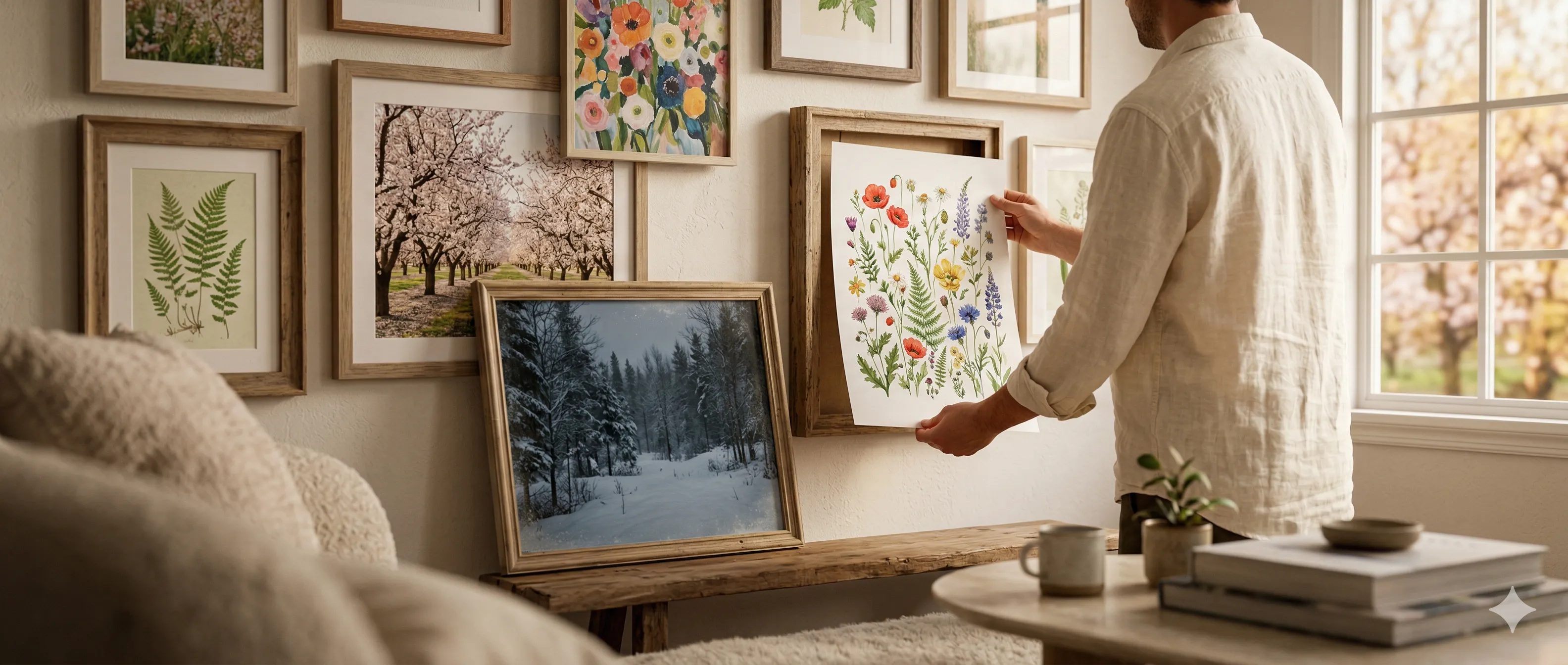
A rotating gallery wall works best when you standardize frame sizes, make the backs easy to open, and build each seasonal set around a clear theme. That lets the wall change without turning every refresh into a full rehang.
Why Rotation Works
A static gallery wall is great — for about six months. Then you stop seeing it. Your eye adapts, and the frames become wallpaper. Rotation forces you to notice your wall again.
Beyond the psychological benefit, rotating galleries are practical:
- Growing families — New photos happen constantly. A rotating wall keeps up.
- Seasonal decor — The same frames can hold autumn landscapes in October and beach photos in June.
- Creative refresh — Tried a salon wall last year? Swap the content and try a color-themed arrangement this spring.
- Renter flexibility — If you move frequently, a rotating system means you’re not committed to one aesthetic.
Designing for Swaps: The Standardization Strategy
The key to easy rotation is standardizing your frame sizes. If every frame on your wall is a unique dimension, swapping content means re-cutting mats, re-printing photos, and potentially rearranging the entire layout. That’s a project, not a quick refresh.
The Standard-Size Framework
Pick 2–3 frame sizes for your wall and stick with them. Prints cut to these sizes will swap in and out without touching the frames.
| Wall Size | Recommended Sizes | Frame Count |
|---|---|---|
| Small (3–4 ft wide) | 5x7 + 8x10 | 3–5 frames |
| Medium (5–6 ft wide) | 8x10 + 11x14 | 5–7 frames |
| Large (7+ ft wide) | 8x10 + 11x14 + 16x20 | 7–12 frames |
Why 2–3 sizes, not one? A wall of identically sized frames looks like a grid (which can be intentional, but limits layout options). Two or three sizes give you visual variety while keeping rotation simple.
Frame Selection for Rotation
| Feature | Why It Matters |
|---|---|
| Top-loading or easy-open backs | You’ll be swapping prints often — avoid frames that require tools to open |
| Standard sizes | Non-standard sizes make it hard to find replacement prints quickly |
| Matching or coordinated finishes | The frames stay; the content changes. Frame consistency provides continuity. |
| Glass or acrylic (not sealed) | You need to access the interior regularly. Sealed shadow boxes are bad candidates for rotation. |
Themed Sets: Ideas by Season
Rotation doesn’t mean random. Each set should have a visual thread — a shared color palette, subject, or mood — so the wall looks curated even after a swap.
Spring
| Theme | Content Ideas |
|---|---|
| Botanicals | Close-up flower photography, botanical illustrations, pressed-flower prints |
| Fresh starts | Light, airy landscapes, pastel abstracts, new family photos from the past few months |
| Color palette | Greens, soft pinks, lavender, white |
Summer
| Theme | Content Ideas |
|---|---|
| Travel | Vacation photos, beach landscapes, city street photography |
| Bold color | Bright abstracts, tropical prints, saturated photography |
| Color palette | Blues, oranges, warm yellows, teal |
Autumn
| Theme | Content Ideas |
|---|---|
| Harvest tones | Woodland photography, moody landscapes, warm-toned abstracts |
| Family portraits | Back-to-school photos, fall family sessions, Thanksgiving memories |
| Color palette | Amber, burnt orange, deep red, olive green, warm brown |
Winter
| Theme | Content Ideas |
|---|---|
| Cozy minimalism | Black and white photography, snowy landscapes, candlelit still life |
| Family and holidays | Holiday photos, kids’ artwork, handwritten recipe cards in frames |
| Color palette | Navy, cream, silver, forest green, burgundy |
The Quarterly Swap Process
Make rotation a ritual, not a chore. Here’s a 30-minute quarterly swap:
| Step | Time | Action |
|---|---|---|
| 1 | 5 min | Pull your next set. Retrieve the prints from storage (see below). |
| 2 | 10 min | Open frames and swap. Work through each frame, removing the current print and inserting the next one. |
| 3 | 5 min | Rehang and level. Put frames back on the wall. Quick level check. |
| 4 | 5 min | Store the outgoing set. File the removed prints in your storage system. |
| 5 | 5 min | Update your GalleryPlanner project. If you use photos in GalleryPlanner, refresh the images to match the current season. |
Storage and Care
The other half of a rotating gallery is what happens to the prints you’re not displaying. Poor storage means faded, creased, or damaged prints when their season comes back around.
Print Storage Best Practices
| Material | Storage Method | Why |
|---|---|---|
| Photo prints | Flat in acid-free sleeves or envelopes, organized by season | Prevents bending, yellowing, and sticking |
| Art prints / posters | Flat in a portfolio case or between acid-free tissue in a drawer | Rolling causes permanent curl at smaller sizes |
| Canvas or thick prints | Upright with cardboard dividers between each piece | Prevents surface scratching and pressure marks |
Storage Container Options
| Option | Cost | Best For |
|---|---|---|
| Photo storage boxes (acid-free) | $10–$20 | Standard photo prints up to 8x10 |
| Art portfolio case | $20–$50 | Larger prints up to 18x24 |
| Under-bed flat storage | $15–$30 | Keeping seasonal sets organized and out of the way |
| Labeled manila envelopes | $5 | Budget option for smaller prints |
Label everything. Use sticky notes or labels on each storage envelope/sleeve: “Spring 2026 - Living Room Gallery.” Future-you will thank present-you.
What Damages Prints in Storage
| Enemy | How It Happens | Prevention |
|---|---|---|
| Sunlight | Stored near windows or in open shelves | Keep in closed containers, away from direct light |
| Humidity | Stored in basements, garages, or bathrooms | Store in climate-controlled areas of the house |
| Pressure | Heavy objects stacked on top | Always store prints flat, never under weight |
| Acid contact | Cheap paper or cardboard touching the print surface | Use acid-free sleeves and dividers |
Building Your First Rotation Set
If you’re starting from scratch, here’s a practical approach:
- Start with one wall. Don’t try to rotate your entire house at once. Pick your most visible gallery wall.
- Buy frames in standard sizes. Two sizes max for your first rotating wall.
- Print two sets. Your current season and the next one. This gives you a head start.
- Store intentionally. Set up your storage system before you have prints to store.
- Schedule the swap. Put a reminder on your calendar for the solstice or equinox. A consistent trigger makes it habitual.
Refresh Your Wall Instantly
GalleryPlanner’s Smart Fill makes seasonal swaps even easier in the planning phase. Add your new seasonal photos to the Library, and Smart Fill will analyze them and suggest which photos work best in which frames — so you can preview your new seasonal arrangement before printing a single photo.
Try Smart Fill in GalleryPlanner →
Ready to Let Smart Fill Help?
Open GalleryPlanner with Smart Fill ready so you can test photo picks directly against your frame layout.
Launch GalleryPlanner