The Gallery Wall Lighting Guide
How to light a gallery wall with picture lights, track lighting, LED strips, color temperature, CRI, glare reduction, and placement rules that work in every room.
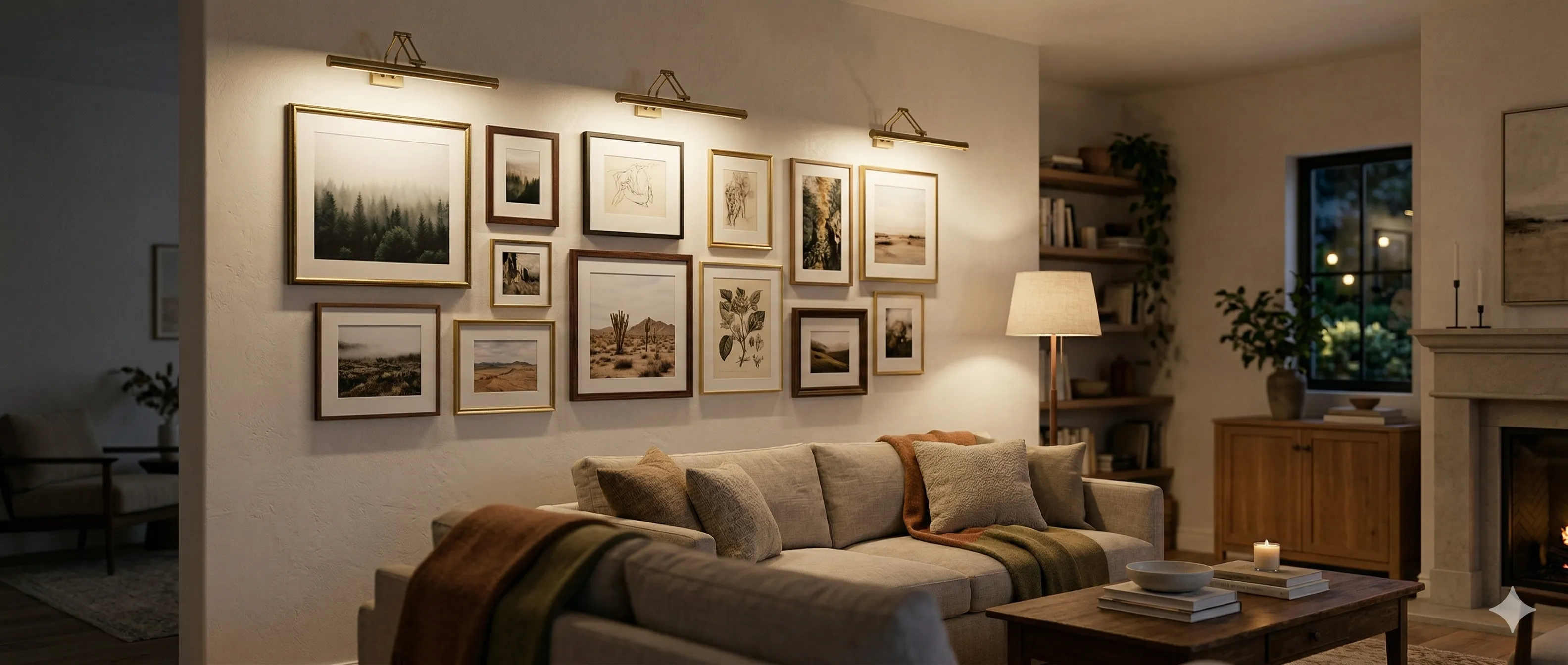
The best gallery wall lighting is focused, adjustable light that makes the art readable without flattening it or making the room feel harsh. Picture lights, track lighting, and LED strips each solve that problem in a different way.
Why Lighting Changes Everything
Museums spend more on lighting than on paint. There’s a reason: light creates depth, draws the eye, and affects how colors read. A warm spotlight makes a photo feel intimate. Flat overhead light makes the same photo feel like a poster in a waiting room.
You don’t need museum-grade fixtures. But even a small upgrade — a single picture light or a well-positioned lamp — can transform your gallery wall from “nice” to “wow, who hung that?”
Types of Art Lighting
Picture Lights
The classic gallery look: a small fixture mounted above a frame (or on the wall behind it) that casts a focused wash of light downward.
| Type | Pros | Cons |
|---|---|---|
| Battery-operated | No wiring, easy to reposition, renter-friendly | Batteries need to be charged or replaced, dimmer output |
| Hardwired | Brightest, cleanest look, no battery hassle | Requires an electrician, permanent placement |
| Plug-in | Good brightness, no electrician needed | Visible cord running down the wall |
Best for: Highlighting individual statement pieces or a small arrangement of 2–4 frames.
Track Lighting
A mounted rail with adjustable heads that you can aim at individual frames. Track lighting is the most flexible option for evolving gallery walls — when you rearrange, you re-aim the heads instead of moving fixtures.
Strengths:
- One installation covers an entire wall.
- Individual heads can be added, removed, or repositioned along the track.
- Available in ceiling-mount and wall-mount styles.
Considerations:
- Requires ceiling or wall installation (usually hardwired).
- Can feel commercial if the track itself is visually heavy — look for low-profile rails.
- Each head should be aimable to at least 30 degrees for proper coverage.
Best for: Large gallery walls (6+ frames) where the layout might change over time.
LED Strip Lighting
Adhesive LED strips mounted behind or around frames create a soft, indirect glow. This is modern ambient lighting rather than focused art lighting — it adds atmosphere without highlighting individual pieces.
Strengths:
- Inexpensive and easy to install (peel-and-stick).
- Often battery or USB powered — no wiring.
- Dimmable options available.
- Creates a dramatic “floating frame” effect when mounted on the back of frames.
Considerations:
- Doesn’t illuminate the artwork directly — it lights the wall around it.
- Can look gimmicky if overdone. Subtlety is everything.
- Quality varies wildly. Cheap strips often flicker, shift color, or fail within months.
Best for: Adding mood lighting to a gallery wall in a media room, bedroom, or hallway where focused task lighting isn’t the goal.
Technical Details That Matter
Color Temperature
Color temperature is measured in Kelvin (K) and determines whether light feels warm or cool.
| Temperature | Feel | Use Case |
|---|---|---|
| 2700K | Warm, golden | Living rooms, bedrooms, hallways — most residential spaces |
| 3000K | Neutral warm | Kitchens, bathrooms, workspaces |
| 4000K+ | Cool, clinical | Avoid for home gallery walls |
Our recommendation: 2700K for most home gallery walls. It flatters skin tones in portraits, adds warmth to landscapes, and feels inviting in the rooms where gallery walls typically live. If your home already skews toward 3000K fixtures, match that instead — consistency across the room matters more than hitting a specific number.
Avoid mixing color temperatures. A 2700K picture light next to a 4000K ceiling fixture creates a visible warm/cool clash on the wall that looks unintentional.
CRI (Color Rendering Index)
CRI measures how accurately a light source renders colors compared to natural daylight. It’s scored from 0 to 100.
| CRI Rating | Quality | What You’ll Notice |
|---|---|---|
| 90+ | Excellent | Colors look rich and true — reds are red, blues are blue |
| 80–89 | Good | Fine for most purposes, slight color flattening |
| Below 80 | Poor | Colors look washed out or muddy — avoid for art lighting |
For gallery walls, aim for CRI 90 or higher. This matters most when lighting photography and artwork where color accuracy is part of the experience. Most quality LED fixtures list their CRI on the box or product page.
Glare Reduction
Glare is the enemy of framed art — especially anything behind glass. A few rules to keep reflections in check:
- Angle your light at 30 degrees from vertical. This is the sweet spot that illuminates the art face without bouncing light back at the viewer.
- Use matte or non-reflective glass in frames that sit under direct lighting.
- Avoid positioning lights directly in front of the frame at eye level — this guarantees a reflection.
- Test at night. Turn off overhead lights and position yourself where you normally view the wall. If you see a bright spot on the glass, adjust the fixture angle.
Placement Rules
Picture Light Positioning
| Parameter | Guideline |
|---|---|
| Height above frame | 4–6 inches above the top edge of the frame |
| Width | Picture light should be 1/3 to 1/2 the width of the frame |
| Angle | Aim downward at roughly 30 degrees |
For frames wider than 30 inches, consider two smaller lights instead of one large one for more even coverage.
Track Lighting Positioning
| Parameter | Guideline |
|---|---|
| Distance from wall | 2–3 feet out from the wall (ceiling mount) |
| Head angle | 30 degrees from vertical toward the wall |
| Spacing | One head per 2–3 frames, depending on beam spread |
Tip: If your track is too close to the wall, the light hits the top of the frame and creates a harsh shadow below. Too far out and you lose the focused gallery effect. The 2–3 foot range is your safe zone.
LED Strip Placement
For the “floating frame” backlight effect:
- Mount strips on the back of the frame, set inward about 1 inch from each edge.
- Aim the LEDs toward the wall (not outward toward the room).
- Use warm white (2700K) strips — RGB color-changing strips look dramatic for about a day and then feel like a college dorm.
The Low-Cost Starting Point
Not ready to commit to hardwired fixtures? Start here:
- One battery-operated picture light on your largest or most important frame. This alone creates a focal point.
- 2700K warm white bulbs in any nearby lamps. Swap out cool-white bulbs to keep the room consistent.
- Test placement at night before mounting anything permanent.
You can always upgrade later. The goal is to see the difference that intentional lighting makes — once you do, you’ll understand why galleries obsess over it.
Plan Before You Wire
If you’re going the hardwired route, plan your frame positions before calling the electrician. Moving a junction box after drywall work is expensive; moving a frame in GalleryPlanner is free.
Plan your gallery wall layout first →
Ready to Plan Your Frames?
Open GalleryPlanner with frame tools ready so you can build your library and start sizing your wall.
Launch GalleryPlanner